
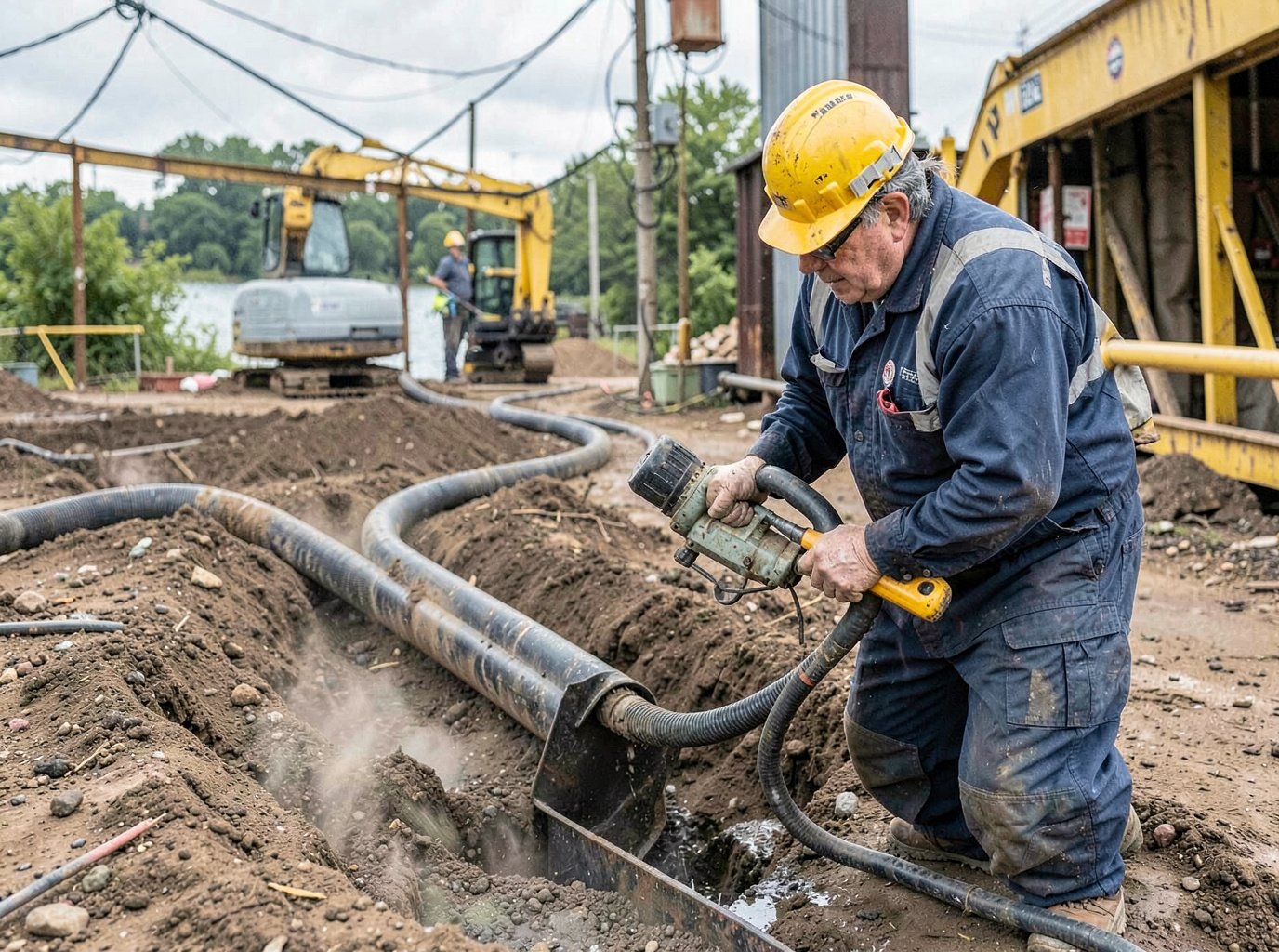
Moore sits on clay-heavy soils in Cleveland County that expand and contract with the humid subtropical climate, pushing tree roots toward sewer lines in neighborhoods like Crestwood and The Highlands. Older housing stock from the 1960s through 1980s often has cast iron or clay pipe that cracks under root pressure, especially after mild winters when roots keep growing. A 3/8-inch cable with a root-cutting head reaches most residential laterals from cleanouts, but operators must watch for brittle sections that can flake during retrieval.
In West Moore and Applewood, grease from frequent home cooking combines with fine sand tracked in from nearby parks like Buck Thomas Park, forming plugs that standard plungers miss. Augering from the roof vent or floor cleanout lets us break the mass without tearing drywall. Hot summer storms dump sudden volumes that expose weak joints in North Moore lines running toward Oklahoma City mains, so we always run a camera after snaking to confirm the cable reached the city tap.
East Moore properties near Sooner Rose Shopping Center sit on flatter grades where solids settle faster, requiring longer 1/2-inch cables on stubborn kitchen lines. We avoid chemical additives that can damage the aging PVC transitions common here and instead use mechanical heads sized to the pipe diameter. After clearing, we flush with city water pressure to verify flow before leaving the site.
Technician insight
In Moore the thing that catches most people out with Drain Snaking & Augering is the clay soil around Kingsbridge and The Highlands that keeps feeding roots into old clay pipe even after mild winters; homeowners often think one quick snake fixes it for good but the grade and soil here mean the same line will need attention again unless they address the trees.
West Moore kitchen backup after summer storms
A Crestwood homeowner called after heavy rain sent water up the kitchen sink. We found the line packed with grease and sand that had settled during the dry spell. Using a 3/8-inch cable from the side cleanout we cut through the plug and flushed the line to the city tap. Flow returned and the camera showed no new cracks in the older section.
Drain Snaking & Augering Services We Offer
✓Main Line Snaking
Clears roots and debris from the primary sewer lateral connecting Moore homes to Cleveland County lines using 3/8-inch and 1/2-inch cables.
✓Kitchen Drain Augering
Breaks grease and food clogs in kitchen lines common in Crestwood and Kingsbridge homes without removing fixtures.
✓Bathroom Sink and Tub Snaking
Removes hair and soap buildup from bathroom drains in older East Moore and Applewood properties using small-diameter augers.
✓Toilet Auger Service
Extracts obstructions from toilet traps and closet bends in West Moore and North Moore homes while protecting porcelain.
✓Floor Drain Clearing
Snakes garage and basement floor drains that collect silt after heavy rains near Buck Thomas Park and Earlywine Park.
Drain Snaking & Augering Cost in OK
| Service | Typical Range | What Affects It |
|---|---|---|
| Standard residential snaking | $175–$350 | Single cleanout access, typical root or grease clog in 3-4 inch lines |
| Extended run or multiple bends | $300–$475 | Longer cable needed for homes in flatter sections of East Moore |
| Toilet-specific augering | $125–$225 | Trap and closet bend only, no main line work |
Ranges are typical for OK and confirmed with an exact written quote before any work starts.
How it works
- 1
Locate Cleanout
We identify the nearest cleanout or roof vent access point based on the home's layout in the specific Moore neighborhood.
- 2
Select Cable And Head
We match cable diameter and cutting head to pipe material and clog type typical for Cleveland County soil conditions.
- 3
Run The Auger
We feed the cable while monitoring resistance to break the clog without forcing through brittle sections.
- 4
Flush And Verify
We run water through the line and check flow at the cleanout before restoring access points.
Pricing
Most Moore drain snaking jobs fall in the mid-hundreds; exact cost depends on access depth, pipe age, and whether a camera inspection follows.